
Breeding and genetics in Show Dogs
How puppies inherit their looks, character and traits, and why inbreeding costs you.
Show Dogs is free on the App Store and Google Play
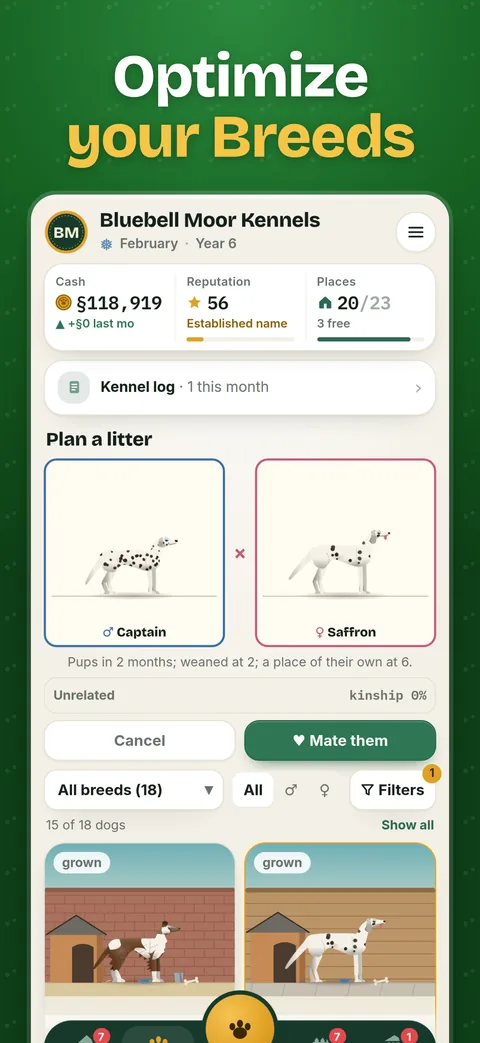
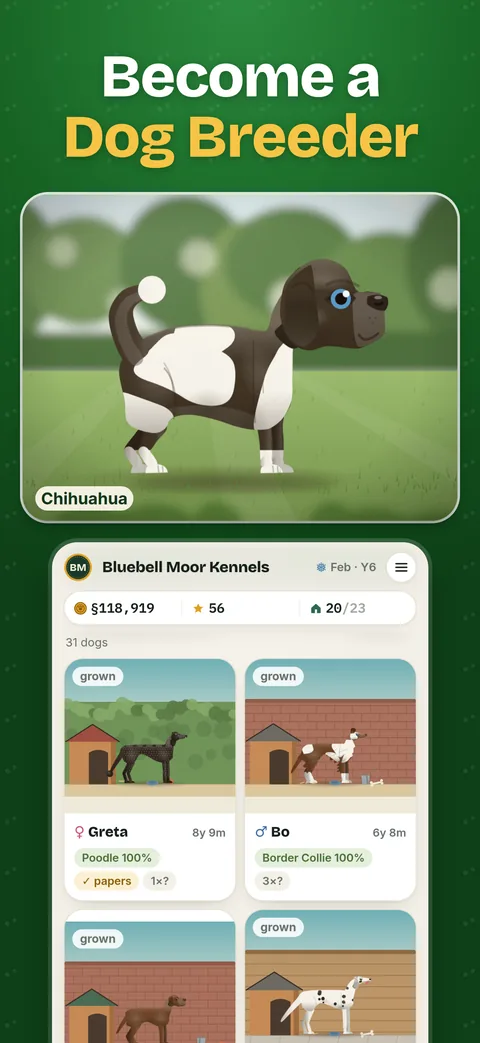
In Show Dogs every puppy inherits coat, colour, ears, tail, build and character from its parents through real genetics, so no two puppies are alike. You plan a litter by choosing a male and a female, and the puppies arrive two months later.
Hereditary conditions work like recessive genes: a dog can carry one without showing it, and two carriers can have an affected puppy.
How a litter works
- Open Plan a litter and choose a male and a female. The screen shows both dogs and how related they are.
- Mate them. A pregnant female gets a label with the months to go.
- Wait two months and see which puppies arrive. Coat, colour, ears, tail, build and character are passed on from the parents.
- Puppies can be sold from two months old. The mother needs some rest before she can have another litter.
What passes from parent to puppy
- Looks: coat, colour, markings, ears, tail and build.
- Character: for example how playful a dog is, and how easily it is trained.
- Traits: 70 traits to discover, good and bad. A dog has no traits or up to five, and some only show up when you use the dog in the ring, on the track, in training or at the vet.
- Ability: how far a dog can be trained depends on its breed and body, and is inherited too.
A trait that one parent has is passed on less often than not, roughly 45% of the time. If both parents have it, it is much more likely, roughly 70%. Now and then a trait appears out of nowhere.
Hereditary conditions and carriers
Eight of the negative traits are hereditary conditions, and they work like real recessive genes.
- Each parent passes on one copy of a gene.
- One copy makes a dog a carrier: you see nothing.
- Two copies give an affected dog.
- Two carriers have a one in four chance of an affected puppy per condition, and half of their puppies are carriers.
Stray dogs carry hidden conditions more often than dogs from top kennels. That is a big part of what you pay for when you buy a papered dog from a top breeder. A vet can find hidden traits, so test before you breed.
Inbreeding
The more closely related two dogs are, the greater the chance that they carry the same hidden gene. In the pedigree screen you can look back one to five generations. A dog that appears more than once in a family tree gets a red mark such as 2×, and the inbreeding percentage is shown. Inbreeding is not forbidden, but it costs you: more hereditary conditions, smaller litters and shorter lives. Bringing in a dog from outside your line, for example from the Kennel Club, is the cure.
Gene lab and rare genes
The game has a gene lab. Win achievements and every new one spins the prize wheel for a rare gene, including colours no dog has ever had. There are 100 of these black market genes. Some, like the ability genes, do not change the dog that receives them, but all its puppies do.
Tips for beginners
- Look at the pedigree before every mating and avoid pairing close relatives.
- Use the vet and your analysis rooms to find hidden traits before you breed a dog.
- Breed towards the breed standard, generation after generation. See dog breeds.
- Keep an eye on the size of the family: a big kennel with few outside dogs becomes inbred sooner than you think.
Frequently asked questions
How does breeding work in Show Dogs?
Choose a male and a female in Plan a litter and mate them. The puppies arrive two months later and inherit looks, character and traits from both parents.
How long is a pregnancy in Show Dogs?
Two months. Puppies can be sold from two months old.
Does Show Dogs use real genetics?
Yes. Coat, colour, ears, tail, build and character are inherited, and hereditary conditions work like real recessive genes with carriers.
What happens if you inbreed dogs in Show Dogs?
The chance of hereditary conditions goes up, litters get smaller and dogs can live shorter lives. The pedigree marks dogs that appear more than once in the tree.
How many traits are there in Show Dogs?
70 traits, good and bad. A dog can have up to five.